There's a popular post going around about Alibaba doing WebAudio fingerprinting and in the process, mucking around with the author's Bluetooth headphones. Here's the tl;dr: browser fingerprinting is a far-too-pervasive method of tracking users across the web, but at least for WebAudio specifically, it's not very effective. Firefox has largely eliminated this fingerprinting vector.
I work on Firefox. Chrome, Brave, Safari probably have defenses against this. I'm pretty sure Chrome's WebAudio code was made approximately constant (like ours) many years ago. It probably still leaks CPU architecture though.
I don't fully agree with the adage "given enough eyeballs, all bugs are shallow" - I think a more true one might be "given enough victims, your attack code is going to change something that makes someone notice". And that's exactly what happened with... sorry, wrong link. That's exactly what happened with Alibaba's fingerprinting code.
If you want to test Alibaba's WebAudio fingerprint, I had claude extract it into a standalone page. My value is sha256:9a388c0dd04cfdc54314f9d961c7e2d247b972067e28d1cea76bd6060cf1392e, and the other value we saw in an internal survey was sha256:16d3191880ce01f726015ec6a1f9a072a81ebd04bf489098d4685d1d1c0b2711.
WebAudio Fingerprinting in Firefox
We made the WebAudio constant in Firefox 118 three years ago as part of our initial round of Fingerprinting Protection features. This eliminated most of the differences.
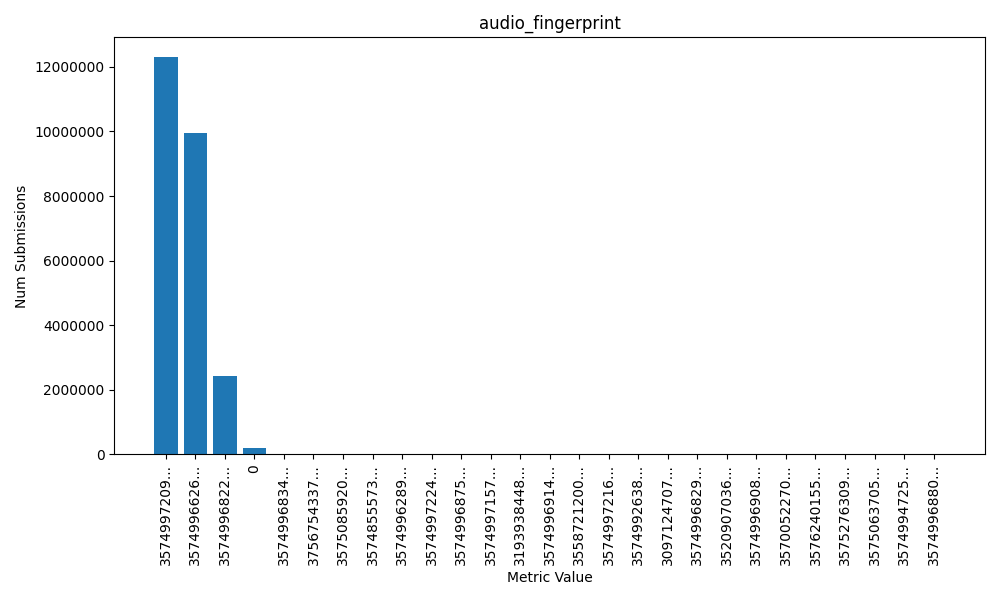
99.24% of users belong to one of three values, and .76% of users had that data collection point fail (a value of zero.) So virtually all users have one of these three values but why are there three values??? Why isn't there one?? Well this is why we collected this telemetry - to ensure we really had made things constant the way we thought we had, and if we hadn't, figure out why and fix it.
The improvements we put into 118 eliminated a lot of differences and I wish I had a graph I could show you of what it looked like before (but I don't.) But what about these remaining three buckets? We were able to figure out that the differences between these are CPU-level differences, which is not surprising given the math operations of audio processing. Specifically one value comes from (all) x86 CPUs and x64 CPUs that lack fused multiply-add instructions, one value from x64 with FMA, and one value from CPUs with the NEON instruction set (ARM).
We followed up on that effort to collapse these buckets into one another. Bug 2036977 collapses the x64 (with FMA3) into the x86/x64 (without FMA3) bucket. Bug 2040494 is on file to collapse the remaining bucket into the NEON bucket but I haven't worked on it in a while because it's just not as high a priority as larger improvements we can make like Sanitizing the WebGL Renderer and Vendor (something I talked a bit about a few months ago).
Because if you've read this far you surely care about the rest of the graph also. There is also the long-tail of 23 other values belonging to 48 other users. This is very unfortunate, as it makes these users completely unique, but it is also not terribly unusual - computers are weird and these results could have been caused by bad RAM, a CPU bug, or possibly some crazy architecture (LoongArch??).
But at the end of the day, WebAudio fingerprinting is nearly useless. I don't expect browser fingerprinting to disappear from websites entirely (unless some regulatory action occurs, fingers crossed) - it's still going to be effective against a majority of users on the web, but at least for privacy focused browsers, it should be wildly less effective.
required, hidden, gravatared
required, markdown enabled (help)
* item 2
* item 3
are treated like code:
if 1 * 2 < 3:
    print "hello, world!"
are treated like code: